November 18, 2026 •
insure2cover •
insurance
Written by the Insure2Cover Content Team | Reviewed by Rohit Negi, Insurance Consultant, insure2cover.com | Last updated: November 2026
Quick Answer
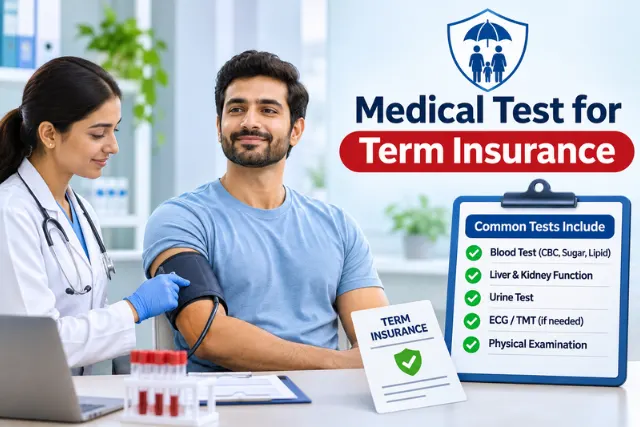
A medical test for term insurance helps insurers assess your health before approving your life insurance application. It may include blood tests, urine tests, blood pressure checks, BMI measurement, ECG, liver and kidney function tests, and other screenings depending on your age, medical history, lifestyle, and chosen sum assured. In most cases, the insurer covers the cost of the required tests. Your medical reports help determine your policy approval, premium, and coverage terms.
You've compared plans, picked a cover amount, filled in the form, and then the screen says "Schedule your medical examination." For a lot of people, this is where buying term insurance suddenly feels a bit nerve-wracking. Will they find something? Will the premium jump? Do I need to take leave from work?
The medical test for term insurance is usually quick, routine, and paid for by the insurer. It isn't an exam you pass or fail. It's simply how the insurer understands your health before promising your family a large payout over the next 20, 30, or 40 years. If you're new to this type of coverage, understanding
what term insurance is can help you make a more informed decision before purchasing a policy.
Why Is a Medical Test for Term Insurance Important? Why Do Insurers Ask for Test?
Term insurance is a long promise. Buy a ₹1 crore cover at 30 till age 70, and the insurer commits to paying your nominee at any point in those 40 years. To price that fairly, it needs a clear picture of your health today.
The medical test helps the insurer's underwriting team check three things:
- Whether your declared health details match your actual health.
- Whether there are risks you don't know about yet, like raised sugar or cholesterol.
- What premium is fair for your risk level.
The medical test for term insurance also helps establish your health profile at the time of application. This gives the insurer a clearer basis for evaluating your coverage and deciding the appropriate premium. In a way, the test protects you too. When your health is verified at the start, there's far less room for dispute at claim time.
Who Needs a Medical Test for Term Insurance?
If you're planning to purchase coverage, learning about the
best age to buy term life insurance can help you understand the benefits of applying earlier. There's no single rule across insurers. It usually depends on these factors:
| Factor |
How it affects your medical requirements |
| Age |
Older applicants are generally asked for more tests |
| Sum assured |
Higher cover usually means more detailed tests |
| Health history |
Declared conditions like diabetes or hypertension often trigger extra checks |
| Lifestyle |
Smokers and tobacco users may face additional screening |
| Income and occupation |
These affect how much cover you qualify for, which in turn affects the tests |
This ties directly into term insurance eligibility. The minimum entry age is typically 18, while the maximum term insurance age limit varies by insurer and plan, so check the brochure before applying. Your age can also influence the premium you pay, so comparing
term insurance rates by age can help you understand how pricing changes over time.
Term Insurance Medical Test List
The medical test for term insurance may include several health screenings, depending on your age, medical history, lifestyle, and selected sum assured. Here are some of the common tests insurers may require during the application process.
| Test |
What it checks |
Usually asked for |
| Physical exam (height, weight, BP, pulse) |
BMI and blood pressure |
Nearly everyone who takes a medical |
| Complete blood count (CBC) |
Anaemia, infection, general blood health |
Most applicants |
| Fasting blood sugar and HbA1c |
Diabetes and average sugar over recent months |
Most applicants |
| Lipid profile |
Cholesterol and triglycerides |
Most applicants |
| Liver function test (LFT) |
Liver health |
Common, especially for higher cover |
| Kidney function test |
Kidney health (e.g. serum creatinine) |
Common, especially for higher cover |
| Urine routine |
Sugar, protein, kidney issues |
Most applicants |
| ECG |
Heart rhythm and basic heart health |
Common, more so as age increases |
| TMT (treadmill test) |
Heart response under physical stress |
Older applicants or very high cover |
| HIV and Hepatitis B screening |
Infectious diseases |
Often part of the standard panel |
| Cotinine test |
Nicotine use |
Sometimes, to verify smoker status |
A quick note on cotinine: if you declared yourself a non-smoker and the test shows nicotine, you may be moved to smoker rates. Declare it upfront.
How the Medical Test Process Works
Once you submit your proposal and make the initial payment, things usually move like this:
- Scheduling: The insurer or its diagnostic partner fixes a date and place. Home sample collection is common.
- Tele-medical call: Some insurers start with a doctor's call about your health history. For some applicants, that's enough.
- Tests: A technician collects blood and urine samples. ECG or other tests happen at home or a centre.
- Reports: Results go straight to the underwriting team. You can usually ask for a copy.
- Decision: The insurer reviews everything and informs you.
The insurer usually pays for tests it asks for, but confirm before booking anything yourself.
How to Prepare for Your Test
A little preparation helps your results reflect your normal health, not one bad day. Preparing properly for a medical test for term insurance helps ensure that your reports reflect your usual health condition. Follow the diagnostic centre's instructions and inform the medical professional about any medicines you take regularly.
The tests and preparation requirements can vary depending on the insurer's assessment, so review the
medical evaluation guidelines provided by ICICI Prudential for an example of how the process works.
- Fast properly: Blood sugar and lipid tests usually need 10 to 12 hours of fasting. Plain water is generally fine.
- Skip alcohol: Avoid drinking for at least 24 hours before, as it can affect liver and sugar readings.
- Hold off on smoking just before: It can push up blood pressure and heart rate.
- Avoid a heavy workout the day before: Intense exercise can temporarily affect some blood markers.
- Carry ID, prescriptions, and old reports: Mention any regular medication.
Never try to "fix" results by skipping regular medication. Just show up as you are.
What Happens After the Test?
Based on your reports and disclosures, the insurer usually does one of the following:
- Accepts at standard rates: Your premium stays as quoted.
- Accepts with loading: You get the policy, but the term insurance premium is higher because of an identified risk.
- Postpones: You're asked to reapply later, for example after recovering from a recent surgery.
- Declines: Uncommon for healthy applicants, but possible.
Once the medical test for term insurance is complete, the underwriting team evaluates your reports alongside your application details. The final decision may affect your policy approval, premium, or coverage terms. If your premium goes up, ask which finding caused it. Managing a condition and retesting later, or trying another insurer, can change the outcome.
Can You Buy Term Insurance Without a Medical Test?
Yes, in some cases. Some insurers offer term insurance without medical test requirements for younger applicants, lower cover amounts, or strong income profiles, relying on a tele-medical interview and your declarations instead.
It's convenient, but your declarations then carry even more weight, and wrong information can hurt at claim time. Our practical take: for a large cover, taking the test isn't a bad thing. It puts your health on record from day one.
Why Honesty Beats "Passing" the Test
Under Section 45 of the Insurance Act, 1938, a life insurance policy cannot be questioned on any ground once three years have passed from the policy date, risk commencement date, or revival date, whichever is later. Within those first three years, though, the insurer can challenge a claim on grounds of fraud or misstatement of material facts.
So hiding diabetes, a past surgery, or smoking can put your family's claim at risk. A slightly higher premium beats a rejected claim. For couples planning their family's financial security, exploring
term insurance for married couples can help them understand their coverage needs.
Documents Required for Term Insurance
Keep these ready alongside your medical test:
- PAN card and another identity proof like Aadhaar or passport
- Address and age proof
- Income proof such as salary slips, ITRs, or Form 16
- Recent photographs
- Past medical records, if you have an existing condition
Having these sorted makes it much easier to buy term insurance online without back-and-forth.
Official Sources Worth Checking
- IRDAI (irdai.gov.in) for regulations and policyholder guidance
- Section 45, Insurance Act, 1938, available on India Code (indiacode.nic.in)
- Bima Bharosa (bimabharosa.irdai.gov.in) for complaints and grievances
- Your chosen insurer's product brochure and policy wording
Conclusion
A medical test for term insurance is an important part of the application process because it helps insurers understand your health and determine the appropriate coverage and premium. Although the examination may seem intimidating, most tests are straightforward and usually arranged by the insurer.
Before your appointment, follow the preparation instructions, keep your medical records ready, and disclose your health conditions and lifestyle habits honestly. Remember, the goal is not simply to get through the medical examination but to provide accurate information so your family has the financial protection you intended to secure.
Frequently Asked Questions
Is the medical test for term insurance free?
In most cases, yes. The insurer pays for the tests it asks for. If you're asked to pay, check whether it's refundable first.
How long does the test take?
Sample collection usually takes 20 to 30 minutes. A TMT or extra tests at a centre can take longer.
Can the test be done at home?
Many insurers offer home collections for blood and urine samples. Tests like TMT generally need a centre visit.
Can I drink water before the test?
Plain water is usually fine during fasting. Avoid tea, coffee, juice, and food unless told otherwise.
What if my sugar or cholesterol is high?
You may still get the policy, possibly at a higher premium. It depends on your readings and overall profile.
Can I get a copy of my reports?
Usually, yes. Ask the insurer or diagnostic centre and keep a copy for your records.
Is term life insurance without a medical test safe?
It can be, as long as your health declarations are honest and complete. The risk lies in wrong disclosures, not in skipping the test.
Do smokers need extra tests?
Often, yes. A cotinine test may be added, and smokers usually pay more.
What if I miss my test appointment?
Simply reschedule. Long delays can hold up your policy, so don't push it too far.
Will a past illness lead to rejection?
Not necessarily. Many past conditions are accepted, sometimes with extra tests or a higher premium.
Do I need a medical test if I'm under 30?
It depends on the cover amount and insurer. Younger applicants with modest cover sometimes only need a tele-medical call.
Does passing the medical test guarantee my claim?
No test "guarantees" a claim. What protects your claim is accurate disclosure in the proposal form.
Disclaimer
This article is intended for informational and educational purposes only. The medical tests, eligibility requirements, underwriting decisions, and premium rates for term insurance may vary between insurers and policy plans. The information provided should not be considered financial, insurance, or medical advice. Always check your chosen insurer's policy brochure, terms and conditions, and medical examination requirements before purchasing a policy. Consult a qualified insurance advisor if you need help understanding your coverage options.