October 21, 2026 •
Rohit Negi •
insurance
Written by the Insure2Cover Content Team | Reviewed by Rohit Negi, Insurance Consultant, insure2cover.com | Last updated: October 2026
Quick Answer
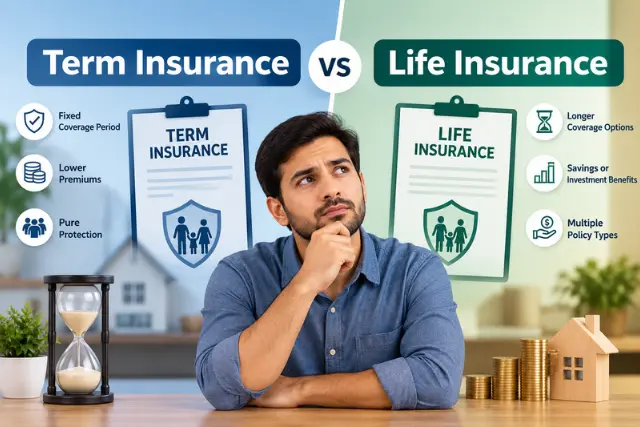
Term Insurance vs Life Insurance comes down to the type of coverage and financial benefits you need. Term insurance is a type of life insurance that provides financial protection for a fixed period, usually at a lower premium than other life insurance products for comparable coverage. Other types of life insurance, such as whole life, endowment, and ULIPs, may offer longer coverage or savings and investment features, depending on the policy. The right choice depends on your family's financial needs, budget, existing obligations, and long-term goals.
Have you bought a policy and got done with it a mere month ago but are still confused whether you should buy “life insurance” or “term insurance”? Trust us, you are not the only one like this. They are supposed to look like rivals but they are not. We are here with something which might help.
Here's the short version. Term insurance is life insurance. It's one type within a much bigger family. So the real question isn't "term insurance vs life insurance" as two opposite products. It's this: do you want pure protection for a fixed number of years, or cover that can last longer and, in some products, build a cash value? Everything below unpacks that, with a real example and a way to decide what fits you.
Is Term Insurance the Same as Life Insurance?
Not exactly but they're not opposites either. Think of life insurance as the whole category and term insurance as one product inside it.
Life insurance is a broad category of policies that provide financial benefits linked to the life of the insured. Depending on the policy, benefits may be payable on death, on maturity, or on other events specified in the contract. Under that umbrella sit several types:
- Term insurance: Pure protection for a set period.
- Whole life plans: Cover designed to last the insured's lifetime, subject to the policy terms.
- Endowment and money-back plans: Protection combined with a savings element.
- ULIPs: Protection combined with a market-linked investment.
So when people compare "term plan vs life insurance," what they usually mean is term insurance vs other types of life insurance, particularly whole life, endowment and investment-linked policies. That's a fair comparison. Just don't fall for the idea that the term isn't "real" life insurance it is.
One myth to drop early: not every life insurance policy builds cash value or returns your money. Term plans generally don't, and that's by design.
Term Insurance vs Life Insurance: The Key Differences
Here's how a straightforward term plan compares with other common types of life insurance, particularly whole life, endowment and investment-linked policies. You can also review the
IRDAI Master Circular on Life Insurance Products for official regulatory guidance on life insurance products.
| Feature |
Term Insurance |
Other Types of Life Insurance |
| Coverage period |
Fixed term |
Depends on the policy |
| Premium |
Generally lower for comparable death cover |
Generally higher for comparable cover |
| Cash / maturity value |
Usually none in a standard term policy |
Depends on the product |
| Main purpose |
Financial protection |
Protection plus other policy objectives |
| Complexity |
Generally simpler |
Varies by product |
| Best suited for |
People seeking substantial protection for a defined period |
People with specific long-term insurance or financial objectives |
A quick but important caveat: a standard term policy generally pays out only if the insured dies during the policy term. If you outlive it, most plans end without a payout — unless the policy specifically provides a maturity or return-of-premium benefit. So read "no maturity benefit" as "true for a plain term plan," not as an absolute rule.
How Does Term Insurance Actually Work?
An example makes this concrete.
Say Rohan is 30, married, with one child and a home loan. He buys a term plan of ₹1 crore for 30 years and pays the applicable premium according to the policy's premium schedule.
- If Rohan dies during the 30-year term while the policy is in force, the insurer will generally pay the death benefit to his nominee, subject to the policy's terms and conditions. That money can help clear the loan, cover his child's education, and replace his income.
- If Rohan is alive and well at 60, when the term ends, the plan simply closes. On a standard plan he doesn't get the premiums back — that's the trade-off for a large safety net at a comparatively low cost.
Term insurance tends to be less expensive than most kinds of permanent or investment life insurance products since the main feature is the pure death benefit protection provided over a period of time, not protection with an investment component.
To see the contrast, picture the same ₹1 crore over 30 years bought instead as a savings-oriented policy. The cover amount might look similar on paper, but part of each premium would go toward building a maturity or cash value which is why such policies generally cost more for the same level of protection. One product is built around pure cover; the other blends cover with a savings goal.
What happens when the term ends?
As the policy nears expiry, your options depend on the product. Some policies may provide renewal or conversion options, depending on the insurer, though any renewal will reflect your older age. In many cases people simply let the cover lapse — by then the loan may be cleared and the children independent, which is a perfectly good outcome, not a loss.
What Counts as "Life Insurance," Then?
Since term is just one branch, it helps to see how varied the rest of the family is. For another example of life insurance, explore
what a Postal Life Insurance scheme is and how it differs from other policy options. Types of life insurance can differ widely in:
- how long they cover you,
- whether premiums stay level or change,
- whether there's a savings, bonus, or investment element,
- and what you receive if you surrender early.
An endowment plan, for instance, is designed to pay a maturity amount if you survive the term. A ULIP links part of your premium to the market. Before choosing this type of policy, review the official
guidance on unit-linked insurance products to understand their charges, benefit illustrations, and other important features. A whole life policy is designed to provide coverage for the insured's lifetime, subject to the policy remaining in force and its terms. None of these is "better" than the term in the abstract they're built for different jobs.
Term Insurance vs Whole Life Insurance
This is the comparison many people are really after, because whole life is the classic counterpart to the term.
| Feature |
Term Life |
Whole Life |
| Coverage |
Fixed term |
Designed to provide lifelong cover, subject to policy terms |
| Premium |
Generally lower |
Generally higher |
| Cash value |
Generally none |
May build cash value, depending on the policy |
| Complexity |
Generally simpler |
Generally more complex |
| Main goal |
Affordable protection |
Lifelong protection and, in some products, cash-value accumulation |
Structures, guarantees, charges, and how any cash value is treated vary a lot between insurers and specific plans. Always read the policy document, not just the brochure.
The Trade-offs: What You Gain and Give Up
- Where term insurance shines - You get a large death benefit for a comparatively low premium, the structure is easy to understand, and you can match the term to your actual responsibilities — say, until your home loan ends or your youngest finishes college.
- Where it falls short - The cover expires. Buying again later costs more because you're older, and if your health has changed, fresh cover may be harder or pricier to get. A plain plan returns nothing if you outlive it.
- Where other life insurance helps - Depending on the product, it can offer lifelong cover, build a cash value you might borrow against, and support estate or legacy goals.
- The downsides there - Premiums are noticeably higher, the products are more complex, charges can apply, and surrendering early often means getting back less than you paid in. They aren't automatically the smarter buy just because "you get something back."
So, Which Is Better: Term Insurance or Life Insurance?
Neither wins on paper. The better choice depends entirely on what you need the policy to do. The same principle applies when choosing health coverage, so you can also learn how to
choose the right health insurance plan.
A term plan usually makes sense if you:
- mainly want to protect your family's income,
- need a large cover amount,
- are working with a limited budget,
- have loans or dependents to shield during your earning years.
Another type of life insurance may be worth considering if you:
- want cover designed to last your whole life,
- have a specific legacy or estate goal,
- genuinely understand and want a savings or investment feature,
- and can comfortably afford the higher premium over the long term.
Some people prefer to keep insurance protection separate from their savings or investments. Whether that approach suits you depends on your financial goals, risk tolerance and overall financial situation.
How Much Cover Do You Actually Need?
This matters more than the term-vs-permanent debate, and most people underestimate it. A rough starting point:
Cover needed ≈ your financial obligations + your family's future needs − your existing savings and cover
In plain terms, add up your outstanding loans, the years of income your family would need to replace, and big future costs like children's education and marriage. Then subtract what you already have savings, investments, and any existing policies.
Some financial-planning approaches use 10–15 times annual income as a starting point, but this is only a rule of thumb. Your age can also influence your premiums, so learn about the
best age to buy term life insurance when planning your coverage. Your actual coverage needs should also account for your debts, dependents, future expenses, existing assets and existing insurance.
What to Check Before You Buy?
Before you sign anything, run through this quick list:
- The cover amount and policy term
- The premium and how it's structured
- Renewal or conversion options, if available
- Exclusions and any waiting periods
- The insurer's claims experience and service record, along with the policy's terms, exclusions and claims process
- Nominee rules and how claims are filed
- Available riders, if offered, such as critical illness, accidental death or waiver of premium
- The free-look period, in case you want to cancel early
Before purchasing, check the insurer's payment instructions and confirm when your coverage becomes effective under the policy terms. And always disclose your health and habits honestly — hiding a material fact can let the insurer decline a claim later.
A Few Myths Worth Clearing Up
- "Term and life insurance are completely different." No – term is a type of life insurance.
- "Term insurance is always the best choice." It's often the most cost-effective for protection, but "best" depends on your goals.
- "All life insurance builds cash value." Only some types do. The term generally doesn't.
- "I can buy the same cover later at the same price." Unlikely. Age, health and underwriting change what you'll pay.
The Bottom Line
Term insurance is life insurance, the version built for affordable, focused protection over a defined period. Other types, like whole life, endowment and investment-linked plans, do a different job: longer cover, and in some products a cash-value component. Neither is automatically better. The right pick comes down to your responsibilities, your budget, and how long you need the cover to last.
If you'd like to see the difference in real numbers, you can compare term insurance and life insurance options side by side on Insure2Cover and choose what genuinely fits your situation.
Frequently Asked Questions (FAQs)
Is term insurance a type of life insurance?
Yes. It's a life insurance product that provides protection for a specified period.
What's the main difference between term and permanent life insurance?
Term insurance generally provides coverage for a specified period without a cash-value component, while some permanent life insurance policies are designed to provide lifelong coverage and may include a cash-value component.
Is term insurance cheaper than whole life?
Generally, yes its primary purpose is protection for a set period rather than combining cover with a savings component.
Does term insurance have a maturity benefit?
A standard term plan usually doesn't pay anything if you outlive the term, unless the policy specifically provides a maturity or return-of-premium benefit.
What happens when term insurance expires?
The cover ends. Depending on the product, you may have renewal or conversion options, generally at a higher premium.
Can I hold both terms and another life insurance policy?
Yes. Many people use a term plan for large, affordable protection and a separate plan for long-term savings goals.
Disclaimer
This article is for general informational purposes only and should not be considered financial, investment, or insurance advice. Policy benefits, premiums, exclusions, maturity benefits, and eligibility vary by insurer and product. Review the official policy documents carefully and consult a qualified financial advisor or licensed insurance professional before making a decision.