July 29, 2026 •
Rohit Negi •
insurance
Written by the Insure2Cover Content Team | Reviewed by Rohit Negi, Insurance Consultant, insure2cover.com | Last updated: July 2026
Quick Answer:
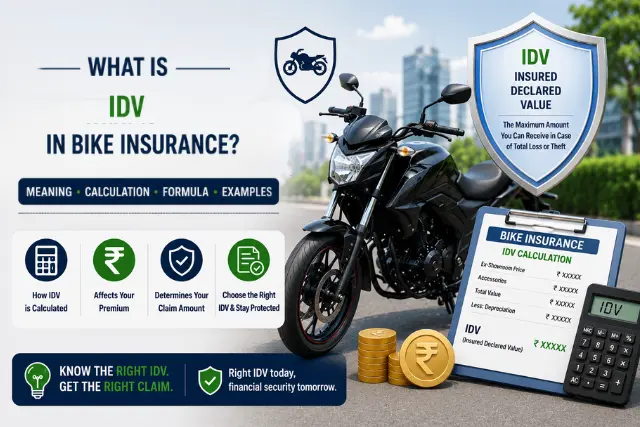
The value of your bike at the present market as determined by your insurance company is its IDV (Insured Declared Value). It is estimated by deducting depreciation from the manufacturer's printed selling price. The IDV is the maximum value for which your general insurance company will compensate you if your bike gets stolen or is damaged completely. In simple terms, it means, IDV = what is the current value of my bike - what will I get back in case of complete damage to the vehicle.
Picture this: your bike gets stolen. You file the claim. And then your insurance company pays you... a lot less than what you expected.
Frustrated? Absolutely. Surprised? You shouldn't be — if you'd understood your IDV in bike insurance before buying the policy.
This single three-letter term — IDV — decides the most important number in your two-wheeler insurance: how much money you'll actually receive if your bike is stolen or damaged beyond repair. And yet, most bike owners have no idea what it means, how IDV is calculated, or why choosing the wrong IDV value can either leave them underinsured or make them overpay every year.
This guide fixes that. No jargon, no unnecessary complexity — just a clear, honest explanation of what IDV in bike insurance really means, how it works, and how to get it right. If you're comparing two-wheeler insurance policies, it's also worth understanding
what NCB in bike insurance means, since both IDV and NCB directly affect your premium and claim benefits.
IDV Full Form and Basic Meaning
Let's start simple.
IDV full form = Insured Declared Value
Simply, insured declared value is the market price of your bike at the time of buying/renewing your wheeler insurance policy- subtracted for depreciation (natural wearing down of the vehicle over the years).
This is the price at which your bike's value is determined between you (policyholder) and your insurer and for that policy term. Using this value, your general insurance provider will establish:
- How much premium you'll pay (higher IDV = higher premium)
- How much you'll receive in a claim if your bike is written off
That's it. That's what IDV in bike insurance fundamentally is.
What is IDV in Bike Insurance?
Think of IDV like the sticker price on your bike today, right now. Not what you bought it for from the showroom, but what it's worth right now. And as the days pass by, your bike's value decreases. Day 1, the day it leaves the showroom, the IDV is roughly equal to its ex-showroom value. Day 1, the day it rolls into your driveway, the value starts to decline. After two years, the IDV is less.
After five years, even less. This inevitable drop in value is called depreciation and it affects your bike's IDV value.
Here's a real-world example:
You buy a Honda Activa 6G in 2022 for ₹80,000 (ex-showroom). In 2024 (2 years later), when you renew your bike insurance, the market value of your bike has drop to roughly ₹64,000 — because IRDAI mandates a 20% depreciation for bikes aged 1–2 years. This ₹64,000 is your bike's IDV value in bike insurance at renewal.
If your bike were stolen in 2024, the insurer would pay you ₹64,000 — not the original ₹80,000 you paid.
This is why IDV is essential — it's not just a policy number, it's your actual financial safety net.
Why IDV is Essential for Every Bike Owner?
Here's where most bike owners get caught off-guard.
Many people just check the premium and buy the cheapest bike insurance available. They don't realise that the insurer may have set an IDV that's significantly lower than the actual market value of your bike — just to make the bike insurance premium look attractive.
When something actually goes wrong — bike is stolen, or a flood writes it off — they discover that the amount they receive barely covers replacing what they lost.
IDV plays a significant role in:
- Total loss claims - If your bike is damaged beyond repair, the insurer pays you the IDV as the settlement.
- Theft claims - If your bike is stolen, your payout is capped at the IDV. Not a rupee more.
- Premium calculation - The higher your IDV, the higher your bike insurance premium — but also the better protected you are.
- Resale decisions - A well-maintained IDV that reflects your bike's true worth ensures you're not carrying a policy that's inadequate for what the bike is actually worth.
Not sure what IDV your current policy has? Check and compare bike insurance plans on Insure2Cover.com — see real IDVs and real premiums from top insurers in minutes.
Understanding how IDV is calculated helps you evaluate whether the value assigned by your insurer is fair. The calculation follows a standard formula prescribed by IRDAI and considers factors such as your bike's age, depreciation, and eligible accessories.
How IDV Is Calculated?
The formula for how IDV is calculated is mandated by
IRDAI and is consistent across all general insurance company-issued policies in India:
IDV Formula:
IDV = (Manufacturer's Listed Selling Price − Depreciation) + (Cost of Accessories not included in Listed Selling Price − Depreciation on Accessories)
Let's break this down:
Manufacturer's Listed Selling Price (MLSP) - The ex-showroom price of your bike at the time of the current policy, as published by the manufacturer. Note: this is not the on-road price. Registration charges, road tax, insurance, and other on-road costs are excluded from the IDV calculation.
Depreciation - The value reduction applied based on your bike's age, as per IRDAI's standard depreciation schedule.
Accessories - Non-standard accessories (like custom exhausts, crash guards, or alloy wheels) installed on your bike that aren't part of the manufacturer's standard list are valued separately — also after depreciation.
Key IRDAI rule: IDV must not exceed 95% of the bike's ex-showroom price for new bikes. Your insurer factors this in automatically.
IRDAI Bike Depreciation Rate Chart (Age-wise)
This is the official IDV depreciation chart used by every general insurance company in India, as prescribed by IRDAI. The older your bike, the higher the depreciation — and the lower your IDV value.
| Bike Age |
Depreciation Rate |
IDV as % of Ex-Showroom Price |
| Up to 6 months |
5% |
95% |
| 6 months to 1 year |
15% |
85% |
| 1 to 2 years |
20% |
80% |
| 2 to 3 years |
30% |
70% |
| 3 to 4 years |
40% |
60% |
| 4 to 5 years |
50% |
50% |
| Above 5 years |
Mutual agreement |
Decided by insurer + policyholder |
Source: IRDAI depreciation schedule — applicable across all two-wheeler insurance policies in India.
The key insight from this table: A 3-year-old two-wheeler retains only 60% of its ex-showroom price as IDV. This means that if you paid ₹1 lakh for your bike, three years later the insurer will pay a maximum of ₹60,000 in a case of total loss — even if you feel your bike is worth more.
After five years, the IDV is no longer tied to a fixed IRDAI percentage. It becomes a mutual agreement between you and the insurer, typically based on the bike's make, model, condition, and available market data.
IDV Calculation — Step-by-Step Example
The example below shows how insurers calculate the insured declared value using the standard depreciation rate and the value of eligible accessories. It makes the IDV formula easier to understand in a real-world scenario.
Let's take a realistic example.
Story: Ravi purchased a Bajaj Pulsar 150 in Jan'22 for 1,20,000 (ex-showroom). He is renewing his two-wheeler insurance in Jan'24 - hence, his bike is exactly 2 years old. He also has some extra accessories fitted (crash guard + usb charger) valued at 5,000.
Step 1 - Determining the Depreciation rateBike age - 2 yearsDepreciation rate- 20% (as per IRDAI chart)
Step 2 - Applying Depreciation to the Bike PriceDepreciation value - 20% on 1,20,000 = 24,000Bike value post depreciation - 1,20,000 - 24,000 = 96,000
Step 3 - calculating Accessory valueDepreciation on accessories - 20% on 5,000 = 1,000Accessory value post depreciation - 5,000 - 1,000 = 4,000
Step 4 - calculating the final IDV IDV = 96,000+ 4,000=1,00,000
So the IDV of Ravi's Pulsar 150 at renewal is 1,00,000. In case the bike gets stolen or is written off in an accident, the insurance company will compensate him an amount not exceeding 1,00,000.
How IDV Affects Your Bike Insurance Premium
This is the relationship that most people intuitively understand but rarely think about carefully:
IDV and bike insurance premium are directly proportional. The higher the IDV, the higher the bike insurance premium you pay. The lower the IDV, the lower the premium — but also the lower your claim payout.
Here's a simplified illustration:
| IDV |
Approx. Annual OD Premium (example) |
Claim Payout if Total Loss |
| ₹80,000 |
~₹1,100–₹1,400 |
₹80,000 |
| ₹95,000 |
~₹1,300–₹1,700 |
₹95,000 |
| ₹1,10,000 |
~₹1,500–₹2,000 |
₹1,10,000 |
Premium varies by insurer, bike model, add-ons, and city. These are illustrative figures for a standard 150cc bike.
The important IRDAI rule: Third-party motor insurance premium is NOT linked to IDV at all — it's fixed by IRDAI based solely on engine cubic capacity (CC). Only the Own Damage (OD) or Comprehensive policy premium is influenced by IDV in bike insurance.
What is A Higher IDV vs Lower IDV?
This is the decision every bike owner faces at renewal time — and most people get it wrong.
Why a Lower IDV Seems Attractive
Some insurers offer artificially low IDVs to make their bike insurance premium look cheaper. At a glance, you save a few hundred rupees a year. Sounds smart, right?
It's not.
If your bike is stolen or totalled the following month, you receive the lower IDV — not what you'd need to replace an equivalent bike. You've saved ₹300 in premium and lost ₹15,000–₹20,000 in your claim settlement.
Why a Higher IDV Isn't Always Better Either
If the selected IDV significantly exceeds the bike's actual market value of your bike, you end up paying more in premium without a corresponding benefit. Most general insurance company-issued policies will not pay more than the actual market value at the time of the claim — so inflating IDV beyond realistic market value is essentially burning money on premium.
The Sweet Spot
The ideal IDV value in bike insurance is as close to the genuine current market value of your bike as possible — not artificially deflated to reduce premium, and not inflated beyond reason.
Insure2Cover recommendation: At every renewal, check the IDV your insurer has calculated. Compare it with your bike's current resale value on platforms like OLX or BikeWale. If the gap is significant, request an adjustment — most insurers allow IDV modification of ±10–15% within the calculated range.
What Is IDV and NCB in Bike Insurance?
Two of the most important terms in two-wheeler insurance — and they work very differently.
|
IDV (Insured Declared Value) |
NCB (No Claim Bonus) |
| What it is |
Current value of your bike |
Discount for claim-free years |
| Affects |
Claim payout on total loss / theft |
Your annual premium |
| How it changes |
Decreases every year with depreciation |
Increases every claim-free year (5% → 50%) |
| Who decides it |
IRDAI depreciation norms + insurer |
IRDAI schedule |
| Can it be transferred? |
No — resets with each policy |
Yes — carries over when you switch insurers |
NCB rewards you for being a safe rider who doesn't make claims. After 5 consecutive claim-free years, your NCB discount can reach 50% off your OD premium — a significant saving. If you're still unsure how the bonus grows every year, read our complete guide on
what NCB in auto insurance stands for to understand how it affects your premium.
IDV is about protection-it's the amount that you would receive should your bike get into any serious trouble.
Both are very important in making your bike insurance inexpensive yet protective. Wise decisions regarding bike insurance deal with both-realistic IDV matching the actual bike value and preserving the NCB by safe riding and cautious claim decisions.
Can You Change IDV While Renewing Bike Insurance?
Yes — and this is a feature most bike owners don't know exists.
At renewal, most insurers allow you to adjust the IDV within a range of ±10% to 15% of the insurer's recommended calculated value. So if your insurer computes your bike's IDV at ₹90,000, you may be able to request an IDV anywhere from ₹76,500 to ₹1,03,500 (roughly).
When should you consider adjusting IDV upward?
- Your bike is well-maintained and its resale value is higher than the standard depreciation suggests
- You ride an in-demand model (like Royal Enfield Bullet or KTM Duke) that holds its value better
- Your bike has quality accessories not reflected in the default calculation
When should you consider adjusting IDV downward?
- Your bike is high-mileage and its actual resale value is below the default calculation
- Premium savings genuinely matter and the bike is older with limited remaining value
- You have alternative vehicles and primarily use this bike occasionally
Never reduce IDV purely to save a few hundred rupees in premium. The risk-reward calculation rarely justifies it.
IDV for Bikes Older Than 5 Years — Mutual Agreement Rule
Once your bike crosses the 5-year mark, the IRDAI's fixed depreciation schedule no longer applies. At this point, the IDV is determined through a mutual agreement between the insurer and you.
In practice, this means:
- The insurer references current resale market data for your bike's make and model
- You can negotiate if you believe the offered IDV doesn't reflect your bike's genuine condition
- Premium bikes (Royal Enfield, KTM, BMW) tend to retain value better and command higher IDVs
- Bikes in excellent condition with documented service records may justify a higher IDV
For bikes above 5 years, always ask for a survey or valuation if the insurer's proposed IDV feels undervalued. Since this is a mutual agreement, your input carries weight — especially if you can demonstrate the bike's current market price through listing data.
Common Mistakes to Avoid with IDV
Many policyholders unknowingly make decisions that reduce their claim amount or increase their insurance costs. Avoiding these common mistakes can help you choose a more suitable IDV and get better value from your bike insurance policy.
Accepting the default IDV without checking - Many bike owners just click "renew" without examining whether their IDV value has been set accurately. Always review it — especially if you switched insurers.
Lowering IDV to save small amounts on premium - Saving ₹200–₹400 per year on bike insurance premium by taking a lower IDV is a terrible trade-off if your bike is stolen or written off. The difference in claim payout can be ₹10,000–₹30,000 or more.
Confusing on-road price with ex-showroom price - IDV is calculated from the manufacturer's listed selling price (ex-showroom price) — not the on-road price that includes registration, road tax, and insurance. Using the on-road price inflates your expected IDV and leads to confusion.
Forgetting to include accessories - If you've installed quality accessories that weren't part of the bike's standard spec, ensure they're listed and covered under your policy. Unregistered accessories are not included in the default IDV calculation and won't be compensated at claim time.
Not checking IDV at every renewal - The IDV changes every year as depreciation increases. A bike owner who set a good IDV 3 years ago may find it misaligned with current market value by now. Annual review is non-negotiable.
Thinking a higher IDV always means a better deal - If your higher IDV significantly exceeds the genuine market value of your bike, you're paying excess premium for a theoretical benefit the insurer will cap at actual market value anyway.
Expert Tips from Insure2Cover
Cross-check your bike's IDV against resale platforms before renewing - Check OLX, BikeWale, and BikeDekho for current selling prices of your exact make, model, and year. If those prices are significantly higher than your insurer's IDV — request an upward adjustment.
Never let IDV drop to an artificially low level just for a cheaper premium - The purpose of motor insurance is protection. A policy that pays you ₹20,000 less than your bike's worth in a case of total loss is not a good deal at any premium level.
Document your accessories properly - If you've invested in quality add-ons — anti-lock braking kits, Bluetooth helmets paired with the bike, custom exhausts — ensure they're listed in your policy documents separately for IDV coverage.
Use the IDV calculator before buying - Most major insurers offer an online IDV calculator — including the tool at Insure2Cover. Use it to see your bike's current value before committing to a policy.
For bikes over 5 years old - negotiate the mutual agreement IDV. Don't accept the first figure. Come with resale data, service records, and visible maintenance as evidence of your bike's actual condition.
Compare IDV across insurers - not just premium. Two insurers may offer similar premiums but with very different IDVs. The one with the more realistic, higher IDV is usually the better protection choice.
Compare bike insurance policies with accurate IDV values.
Get free quotes at Insure2Cover.com — transparent IDV display, real premiums, top insurers.
Conclusion
If you've read this far, you now know something that most bike owners in India don't: IDV is not just a number on your policy document — it's your financial safety net.
Insured declared value is the maximum amount your insurer will pay you if your bike is stolen or lost completely. It's calculated by deducting IRDAI-mandated depreciation from your bike's ex-showroom listed selling price. It changes every year. It directly affects your bike insurance premium. And it's something you have partial control over — at every renewal.
Getting your IDV in bike insurance right means:
- Not paying excess premium on an inflated IDV
- Not being underinsured because you chased a cheaper premium with a deflated IDV
- Being confident that in a case of total loss or theft, you'll receive what your bike was genuinely worth
The agreement between the insurer and you at renewal time isn't just a formality — it's a financial decision. Make it an informed one.
At Insure2Cover, we show you every plan's IDV upfront — no surprises, no fine-print tricks. Just honest, transparent bike insurance comparison from India's top insurers.
Key Takeaways
- IDV full form = Insured Declared Value — the current market value of your bike after depreciation
- IDV is the maximum amount your general insurance company pays in case of theft or total loss
- IDV is calculated using the formula: (Listed Selling Price − Depreciation) + (Accessories − Accessories Depreciation)
- IRDAI sets standard depreciation rates: 5% (under 6 months) → 50% (4–5 years); above 5 years = mutual agreement
- Higher IDV = higher bike insurance premium but better claim payout — and vice versa
- IDV does NOT apply to third-party insurance; it only affects Own Damage (OD) and Comprehensive policies
- IDV and NCB both play a significant role in two-wheeler insurance — IDV determines claim value, NCB reduces premium
- At renewal, you can adjust IDV within ±10–15% of the calculated value — always review before renewing
- Never lower IDV purely to reduce premium — the risk far outweighs the small annual saving
Frequently Asked Questions (FAQs)
What is IDV in bike insurance?
IDV in bike insurance stands for Insured Declared Value — the current market value of your bike after deducting depreciation from the manufacturer's listed selling price. It is the maximum amount your insurer will pay in the case of total loss or if your bike is stolen. It is decided through an agreement between the insurer and policyholder.
What is the IDV full form in insurance?
IDV full form = Insured Declared Value. In motor insurance, insured declared value is the standardised current worth of your vehicle. It is calculated by subtracting IRDAI-mandated depreciation from the ex-showroom (manufacturer's listed selling price) of your two-wheeler.
How is IDV calculated for bike insurance?
IDV is calculated as: (Manufacturer's Listed Selling Price − Depreciation) + (Accessories not in standard list − Depreciation on Accessories). The depreciation rate is fixed by IRDAI based on the bike's age — ranging from 5% for bikes under 6 months old to 50% for bikes aged 4–5 years.
What is the IDV depreciation chart for two-wheelers?
The IRDAI bike depreciation rate chart: Under 6 months = 5%, 6 months–1 year = 15%, 1–2 years = 20%, 2–3 years = 30%, 3–4 years = 40%, 4–5 years = 50%. Above 5 years, IDV is decided through mutual agreement between insurer and policyholder.
Does a higher IDV mean a higher bike insurance premium?
Yes. IDV and bike insurance premium are directly proportional — a higher IDV means a higher premium but also a higher claim payout in a case of total loss or theft. Conversely, a lower IDV reduces premium but leaves you underinsured. The goal is to set IDV as close to your bike's genuine current market value as possible.
What is IDV and NCB in bike insurance?
IDV (Insured Declared Value) is the current market value of your bike — it determines how much you get in a theft or total loss claim. NCB (No Claim Bonus) is a discount on your premium earned for every claim-free year (up to 50% after 5 years). IDV affects your claim payout; NCB reduces your annual premium. Both play a significant role in your wheeler insurance policy.
Can I change the IDV when renewing bike insurance?
Yes. Most insurers allow you to adjust your IDV value within approximately ±10–15% of the calculated amount at renewal. You can request a higher IDV if your bike's resale value justifies it, or a lower IDV if you want to reduce your bike insurance premium — though lowering IDV significantly is generally not advisable.
Is IDV applicable to third-party bike insurance?
No. IDV applies only to Own Damage (OD) and Comprehensive two-wheeler insurance policies. Third-party motor insurance premiums are fixed by IRDAI based solely on the engine's cubic capacity (CC) — they have no connection to the bike's IDV value.
What happens to IDV when the bike is more than 5 years old?
After 5 years, the standard IRDAI depreciation schedule no longer applies. The IDV for bikes older than 5 years is determined through a mutual agreement between the insurer and the policyholder, typically based on the bike's make, model, current condition, mileage, and prevailing second-hand market prices.
What is meant by IDV in bike insurance in simple words?
In simple terms: IDV in bike insurance is the "current price tag" of your bike — what it's worth today, not what you paid for it. It is the amount your general insurance company agrees to pay you if your bike is stolen or completely written off. It decreases every year as your bike ages and depreciates in value.
All depreciation rates referenced are as per IRDAI's standard two-wheeler depreciation schedule. Premiums shown are indicative and vary by insurer, bike model, city, and applicable add-ons. For accurate IDV calculation and policy comparison, visit insure2cover.com.